ConcurrentHashMap是并发安全的HashMap。ConcurrentHashMap设计比较复杂,涉及的知识比较多,建议先看看:
同样以java8作为分析。
ConcurrentHashMap 简介
类似HashMap,使用数组+链表+红黑树的方式实现。 负载因子loadfactor,初始化大小initialCapacity,默认容量DEFAULT_CAPACITY,链表转红黑树TREEIFY_THRESHOLD都和HashMap一样。
ConcurrentHashMap数组
table(非扩容时使用)、nextTable(扩容时使用)都使用volatile修饰,保证并发修改的可见性,关于volatile,见
transient volatile Node<K,V>[] table;
private transient volatile Node<K,V>[] nextTable;
为了操作table、nextTable,使用Unsafe类提供的getObjectVolatile、putObjectVolatile等方法。
@SuppressWarnings("unchecked")
static final <K,V> Node<K,V> tabAt(Node<K,V>[] tab, int i) {
    return (Node<K,V>)U.getObjectVolatile(tab, ((long)i << ASHIFT) + ABASE);
}

static final <K,V> boolean casTabAt(Node<K,V>[] tab, int i,
                                    Node<K,V> c, Node<K,V> v) {
    return U.compareAndSwapObject(tab, ((long)i << ASHIFT) + ABASE, c, v);
}

static final <K,V> void setTabAt(Node<K,V>[] tab, int i, Node<K,V> v) {
    U.putObjectVolatile(tab, ((long)i << ASHIFT) + ABASE, v);
}
ConcurrentHashMap Node
static class Node<K,V> implements Map.Entry<K,V> {
    final int hash;
    final K key;
    volatile V val;
    volatile Node<K,V> next;
}
Node的结构和HashMap.Node相似,但是val和next都使用volatile修饰,保证并发修改的可见性。 hash字段存放节点的哈希值。ConcurrentHashMap定义了几个特殊值:
/*
 * Encodings for Node hash fields. See above for explanation.
 */
static final int MOVED     = -1; // hash for forwarding nodes
static final int TREEBIN   = -2; // hash for roots of trees
static final int RESERVED  = -3; // hash for transient reservations
static final int HASH_BITS = 0x7fffffff; // usable bits of normal node hash
MOVED、TREEBIN、RESERVED是为了对应的特殊节点使用。HASH_BITS是普通节点计算哈希时使用。
ForwardingNode
ForwardingNode,扩容的时候使用。hash值为MOVED(-1)。
/**
 * A node inserted at head of bins during transfer operations.
 */
static final class ForwardingNode<K,V> extends Node<K,V> {
    final Node<K,V>[] nextTable;
    ForwardingNode(Node<K,V>[] tab) {
        super(MOVED, null, null, null);
        this.nextTable = tab;
    }
}
TreeBin
TreeBin是红黑树,对应hash值为TREEBIN(-2)。
ReservationNode
ReservationNode在computeIfAbsent时候使用,对应hash为RESERVED(-3)。因为是占位符,不需要具体的key、value。
/**
 * A place-holder node used in computeIfAbsent and compute
 */
static final class ReservationNode<K,V> extends Node<K,V> {
    ReservationNode() {
        super(RESERVED, null, null, null);
    }
}
ConcurrentHashMap计算hash
同HashMap一样,为了定位key在table[]哪个位置,先做哈希计算。
计算hash的方式和HashMap类似,都会使用(h ^ (h >>> 16)),兼顾速度和降低冲突;但是ConcurrentHashMap多了一次对HASH_BITS按位与。
    static final int spread(int h) {
        return (h ^ (h >>> 16)) & HASH_BITS;
    }
上面提到,HASH_BITS是普通节点使用。
ConcurrentHashMap put()
- key或者value不能为null
if (key == null || value == null) throw new NullPointerException();
- 计算hash
int hash = spread(key.hashCode());
- 遍历table,定位key的位置。 table[]和nextTable[]都是volatile修饰,这里使用Unsafe类直接访问指定槽位的内存数据 如果指定槽位为null,那么尝试cas方式插入节点
if ((f = tabAt(tab, i = (n - 1) & hash)) == null) {
                if (casTabAt(tab, i, null,
                             new Node<K,V>(hash, key, value, null)))
                    break;                   // no lock when adding to empty bin
            }
如果正在resize,则参与扩容(扩容细节先按下不表)
if ((fh = f.hash) == MOVED)
                tab = helpTransfer(tab, f);
否则,对该槽位加锁。然后根据链表或者红黑树方式更新value。 留意这里使用synchronized方式加锁,并且再次检查节点的hash
V oldVal = null;
// 使用synchronized方式加锁
synchronized (f) {
    // 如果槽位已经不是节点f,则不做处理
    if (tabAt(tab, i) == f) {
        // fh > 0,是普通节点,并且是链表形式
        if (fh >= 0) {
            // 在链表分支中,binCount统计已经查找的节点数量
            // 如果该链表访问的节点数量到达TREEIFY_THRESHOLD,则进行转换
            binCount = 1;
            for (Node<K,V> e = f;; ++binCount) {
                K ek;
                if (e.hash == hash &&
                    ((ek = e.key) == key ||
                     (ek != null && key.equals(ek)))) {
                    oldVal = e.val;
                    if (!onlyIfAbsent)
                        e.val = value;
                    break;
                }
                Node<K,V> pred = e;
                if ((e = e.next) == null) {
                    pred.next = new Node<K,V>(hash, key,
                                              value, null);
                    break;
                }
            }
        }
        // 否则,是特殊节点,检查是否红黑树
        else if (f instanceof TreeBin) {
            Node<K,V> p;
            binCount = 2;
            if ((p = ((TreeBin<K,V>)f).putTreeVal(hash, key,
                                           value)) != null) {
                oldVal = p.val;
                if (!onlyIfAbsent)
                    p.val = value;
            }
        }
    }
}
- 检查是否进行链表转换红黑树
if (binCount != 0) {
    if (binCount >= TREEIFY_THRESHOLD)
        treeifyBin(tab, i);
    if (oldVal != null)
        return oldVal;
    break;
}
- 更新计数,可能发生扩容。具体在后面再说
addCount(1L, binCount);
小结:
- ConcurrentHashMap并发修改,如果table[x]是null则尝试CAS方式放入新节点,否则通过对table[x]槽位同步(synchronized)来实现线程安全。
- 标记table[x]正在扩容的方式是,table[x]节点的hash修改为MOVED
- ConcurrentHashMap支持多个线程参与table[x]的扩容helpTransfer()
ConcurrentHashMap get()
public V get(Object key) {
    Node<K,V>[] tab; Node<K,V> e, p; int n, eh; K ek;
    int h = spread(key.hashCode());
    if ((tab = table) != null && (n = tab.length) > 0 &&
        (e = tabAt(tab, (n - 1) & h)) != null) {
        // 槽位的第一个节点
        if ((eh = e.hash) == h) {
            if ((ek = e.key) == key || (ek != null && key.equals(ek)))
                return e.val;
        }
        // 该节点处于特殊状态,(MOVED、RESERVED),或者是红黑树
        else if (eh < 0)
            return (p = e.find(h, key)) != null ? p.val : null;
        // 普通节点,且是链表,遍历该槽位的所有节点
        while ((e = e.next) != null) {
            if (e.hash == h &&
                ((ek = e.key) == key || (ek != null && key.equals(ek))))
                return e.val;
        }
    }
    return null;
}
ConcurrentHashMap支持并发修改,因此get的时候,某个槽位可能处于特殊状态(MOVED、RESERVED),或者是红黑树,因此使用Node提供的find方法遍历。
static class Node<K,V> implements Map.Entry<K,V> {
    /**
     * Virtualized support for map.get(); overridden in subclasses.
     */
    Node<K,V> find(int h, Object k) {
        Node<K,V> e = this;
        if (k != null) {
            do {
                K ek;
                if (e.hash == h &&
                    ((ek = e.key) == k || (ek != null && k.equals(ek))))
                    return e;
            } while ((e = e.next) != null);
        }
        return null;
    }
}
Node的子类会覆盖find。
TreeNode使用红黑树方式查找
static final class TreeNode<K,V> extends Node<K,V> {
    Node<K,V> find(int h, Object k) {
        return findTreeNode(h, k, null);
    }
}
ReservationNode用在computeIfAbsent,只是占位符,因此直接返null。
static final class ReservationNode<K,V> extends Node<K,V> {
    Node<K,V> find(int h, Object k) {
        return null;
    }
}
ForwardingNode表明该位置正在发生resize。遍历的时候可能遇上节点也在做resize,Java实现上使用循环+代码块跳转,避免陷入多层递归。
static final class ForwardingNode<K,V> extends Node<K,V> {
    final Node<K,V>[] nextTable;
    ForwardingNode(Node<K,V>[] tab) {
        super(MOVED, null, null, null);
        this.nextTable = tab;
    }
    Node<K,V> find(int h, Object k) {
        // loop to avoid arbitrarily deep recursion on forwarding nodes
        outer: for (Node<K,V>[] tab = nextTable;;) {
            Node<K,V> e; int n;
            if (k == null || tab == null || (n = tab.length) == 0 ||
                (e = tabAt(tab, (n - 1) & h)) == null)
                return null;
            for (;;) {
                int eh; K ek;
                if ((eh = e.hash) == h &&
                    ((ek = e.key) == k || (ek != null && k.equals(ek))))
                    return e;
                // 特殊状态的节点
                if (eh < 0) {
                    // 遇到ForwardingNode,则跳出当前循环,避免递归
                    if (e instanceof ForwardingNode) {
                        tab = ((ForwardingNode<K,V>)e).nextTable;
                        continue outer;
                    }
                    else
                        return e.find(h, k);
                }
                if ((e = e.next) == null)
                    return null;
            }
        }
    }
}
get方法小结:
- 不需要加锁
ConcurrentHashMap computeIfAbsent()
computeIfAbsent: 如果没有对应的key,则执行mappingFunction计算,并且保证最多只计算一次。
public V computeIfAbsent(K key, Function<? super K, ? extends V> mappingFunction)
考虑并发线程使用computeIfAbsent对同一个key操作。那么正常情况下,mappingFunction只被计算一次。 从执行mappingFunction得到value,到新建node保存key-value,不是原子化操作,因此要有机制实现。
ConcurrentHashMap的设计是:
- 目标槽位为null:CAS设置一个占位符,使用了ReservationNode。
if ((f = tabAt(tab, i = (n - 1) & h)) == null) {
    Node<K,V> r = new ReservationNode<K,V>();
    synchronized (r) {
        if (casTabAt(tab, i, null, r)) {
            binCount = 1;
            Node<K,V> node = null;
            try {
                if ((val = mappingFunction.apply(key)) != null)
                    node = new Node<K,V>(h, key, val, null);
            } finally {
                setTabAt(tab, i, node);
            }
        }
}
- 目标槽位不为null:对这个槽位加锁
synchronized (f) {
    // 分开链表、红黑树操作
}
小结:
- ReservationNode用于computeIfAbsent,当目标槽位为null时作为占位符。
ConcurrentHashMap 扩容机制: transfer & helpTransfer
ConcurrentHashMap的扩容机制相对HashMap更加复杂。 ConcurrentHashMap的扩容,也是新建newTable,然后把原来table元素搬运到到newTable。但是这个搬运动作是并发!默认并发度是16(MIN_TRANSFER_STRIDE)。
private static final int MAX_RESIZERS = (1 << (32 - RESIZE_STAMP_BITS)) - 1;
/**
 * The number of bits used for generation stamp in sizeCtl.
 * Must be at least 6 for 32bit arrays.
 */
private static int RESIZE_STAMP_BITS = 16;
/**
 * Minimum number of rebinnings per transfer step. Ranges are
 * subdivided to allow multiple resizer threads.  This value
 * serves as a lower bound to avoid resizers encountering
 * excessive memory contention.  The value should be at least
 * DEFAULT_CAPACITY.
 */
private static final int MIN_TRANSFER_STRIDE = 16;
除了上面3个和并发度相关的参数,还有sizeCtl变量
/**
 * Table initialization and resizing control.  When negative, the
 * table is being initialized or resized: -1 for initialization,
 * else -(1 + the number of active resizing threads).  Otherwise,
 * when table is null, holds the initial table size to use upon
 * creation, or 0 for default. After initialization, holds the
 * next element count value upon which to resize the table.
 */
private transient volatile int sizeCtl;
sizeCtl:
- -1:正在初始化
- 其他负数:有N-1个线程正在进行扩容操作
- 0或者正数:table没有初始化;或者下一轮resize要调整的数量
和扩容相关的方法是transfer和helpTransfer。
TODO: 具体扩容比较复杂,先挖个坑,以后单独文章介绍。
ConcurrentHashMap 获取大小
获取容量大小有2个方法:
- size:java集合类覆盖的方法。返回int
- mappingCount:java8以后新增的。返回long。推荐使用此方法。
public int size() {
    long n = sumCount();
    return ((n < 0L) ? 0 :
            (n > (long)Integer.MAX_VALUE) ? Integer.MAX_VALUE :
            (int)n);
}

/**
 * Returns the number of mappings. This method should be used
 * instead of {@link #size} because a ConcurrentHashMap may
 * contain more mappings than can be represented as an int. The
 * value returned is an estimate; the actual count may differ if
 * there are concurrent insertions or removals.
 *
 * @return the number of mappings
 * @since 1.8
 */
public long mappingCount() {
    long n = sumCount();
    return (n < 0L) ? 0L : n; // ignore transient negative values
}
不管是size还是mappingCount,都会使用sumCount
final long sumCount() {
    CounterCell[] as = counterCells; CounterCell a;
    long sum = baseCount;
    if (as != null) {
        for (int i = 0; i < as.length; ++i) {
            if ((a = as[i]) != null)
                sum += a.value;
        }
    }
    return sum;
}
如果counterCells不为null,则遍历counterCells,把value加上到baseCount。否则直接返回baseCount。 疑问:
- baseCount的用途?在什么时候更新?
- counterCells是什么?在什么时候更新?
先看baseCount,在没有竞争的情况下使用,通过CAS方式更新。BASECOUNT在addCount和fullAddCount使用。
/**
 * Base counter value, used mainly when there is no contention,
 * but also as a fallback during table initialization
 * races. Updated via CAS.
 */
private transient volatile long baseCount;

BASECOUNT = U.objectFieldOffset
    (k.getDeclaredField("baseCount"));
CounterCell用来做发生冲突时的计数。还有个关联的cellsBusy变量,表示正在使用自旋锁更新counterCells。
 /**
  * Spinlock (locked via CAS) used when resizing and/or creating CounterCells.
  */
 private transient volatile int cellsBusy;
 /**
  * Table of counter cells. When non-null, size is a power of 2.
  */
 private transient volatile CounterCell[] counterCells;
CounterCell的数据结构很简单,只有一个long类型的value保存计数。但是使用了@sun.misc.Contended注解,同时javadoc表示从LongAdder和Striped64改造。这里先不做扩展。
/**
 * A padded cell for distributing counts.  Adapted from LongAdder
 * and Striped64.  See their internal docs for explanation.
 */
@sun.misc.Contended static final class CounterCell {
    volatile long value;
    CounterCell(long x) { value = x; }
}
在ide中查找引用,发现只在fullAddCount方法修改counterCells
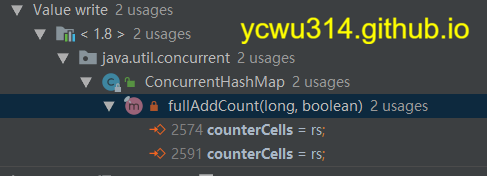
fullAddCount又有温馨提示了,具体要看LongAdder的设计。
// See LongAdder version for explanation
private final void fullAddCount(long x, boolean wasUncontended) {
Striped64、LongAdder文章:
fullAddCount被addCount调用。
/**
 * Adds to count, and if table is too small and not already
 * resizing, initiates transfer. If already resizing, helps
 * perform transfer if work is available.  Rechecks occupancy
 * after a transfer to see if another resize is already needed
 * because resizings are lagging additions.
 *
 * @param x the count to add
 * @param check if <0, don't check resize, if <= 1 only check if uncontended
 */
private final void addCount(long x, int check) {
    CounterCell[] as; long b, s;
    // 如果有可用的counterCells,并且CAS更新baseCount失败,
    if ((as = counterCells) != null ||
        !U.compareAndSwapLong(this, BASECOUNT, b = baseCount, s = b + x)) {
        CounterCell a; long v; int m;
        boolean uncontended = true;

        if (as == null || (m = as.length - 1) < 0 ||                        // 检查counterCells是否可用
            (a = as[ThreadLocalRandom.getProbe() & m]) == null ||           // 随机找一个可用(即null)的counterCell槽位
            !(uncontended =
              U.compareAndSwapLong(a, CELLVALUE, v = a.value, v + x))) {    // 并且在该槽位上更新失败
            fullAddCount(x, uncontended);                                   // 则执行fullAddCount
            return;
        }
        // 执行此处,表明已经CAS更新了counterCell
        if (check <= 1)
            return;
        s = sumCount();
    }
    // 需要resize。这里先不深入
    if (check >= 0) {
        Node<K,V>[] tab, nt; int n, sc;
        while (s >= (long)(sc = sizeCtl) && (tab = table) != null &&
               (n = tab.length) < MAXIMUM_CAPACITY) {
            int rs = resizeStamp(n);
            if (sc < 0) {
                if ((sc >>> RESIZE_STAMP_SHIFT) != rs || sc == rs + 1 ||
                    sc == rs + MAX_RESIZERS || (nt = nextTable) == null ||
                    transferIndex <= 0)
                    break;
                if (U.compareAndSwapInt(this, SIZECTL, sc, sc + 1))
                    transfer(tab, nt);
            }
            else if (U.compareAndSwapInt(this, SIZECTL, sc,
                                         (rs << RESIZE_STAMP_SHIFT) + 2))
                transfer(tab, null);
            s = sumCount();
        }
    }
}
addCount小结:
- 尝试CAS更新baseCount。如果有竞争,则使用fullAddCount。
- fullAddCount参考了LongAdder的设计
ConcurrentHashMap 并发度
ConcurrentHashMap大量使用CAS更新,只有失败才进行同步。从上面代码可见,同步的位置是table[x]。因此并发度是table的长度。
Java7的ConcurrentHashMap
HashMap、ConcurrentHashMap都在Java8增加了链表转红黑树,设计复杂了。 对比Java 7 ConcurrentHashMap.java,Java8的Java7中的Segment数组对应Java8中table数组。但是真实数据存放在HashEntry类型的table数组。
final Segment<K,V>[] segments;
static final class Segment<K,V> extends ReentrantLock implements Serializable {
    transient volatile HashEntry<K,V>[] table;
}
每个Segment就是一个ReentrantLock。如果要加锁,直接使用ReentrantLock.lock。 在Java8,要对槽位加锁,使用synchronized。
我的理解是:
- Java对synchronized优化,和ReentrantLock相差越来越少
- 随着ConcurrentHashMap扩容,并发度越大,单个槽位的竞争变少
- ConcurrentHashMap把所有节点(链表节点、红黑树、特殊状态节点)都抽象统一为Node类型,槽位也能直接存放数组,并且优先使用CAS更新。CAS要比ReentrantLock更加轻量。
- 如果使用继续使用ReentrantLock,那么消耗大量存储空间(ReentrantLock底层使用AQS。同时所有Node都变成了ReentrantLock,完全没有这个必要)。
ConcurrentHashMap 小结
- ConcurrentHashMap不支持key或者value为null。
- ConcurrentHashMap的并发度是table[]的长度,默认是16。背后的设计思路是优先CAS更新、失败则使用synchronized加锁(缩小加锁范围)。
- ConcurrentHashMap并发扩容使用sizeCtl控制
- ConcurrentHashMap有3种特殊类型的节点:TreeNode(红黑树),ReservationNode(用于computeIfAbsent的占位符),ForwardingNode(resize标记)
- ConcurrentHashMap可以使用size或者mappingCount获取容量大小。java8以后推荐使用mappingCount方法。
- CounterCell保存在竞争条件下CAS更新baseCount失败的计数
- 计数更新:使用addCount()尝试CAS更新baseCount,如果失败则使用fullAddCount()。
- fullAddCount设计参考了LongAdder
ConcurrentHashMap值得反复品味的设计细节很多。